Power,
a common used term, is not what it seems as I have learning BA1002 lectures and
tutorials. The complex world of power, and its relation to space and place and
the network theory will be discussed.
To
understand the complexities of power, the virtual social network of Facebook
will be analysed throughout the blogs. Facebook is arguably the largest network
or hub that connects people from all around the world. It allows one to
interact and stay connected with friends and family. This vast virtual space
becomes a personal place as it enables us to interact with family and friends.
Facebook is no longer a conceptual space, the user creates a direct
relationship by interacting with its features. Tuan (1977, p. 4) writes,
"Places are centers of felt value, where biological needs… are
satisfied".
Additionally
space is deeply linked with power; like space, power is relational. The
geography of power determines how it is exercised and it relies on relationships.
Allen (2003, p. 2) states, "…geography matters to our relationships with those who exercise
power and, … power matters to what can be said geographically about its
exercise".
This
idea of geography and power relates to the use of Facebook through the
Panopticon Theory. "In Many ways, Facebook is reminiscent of the
panopticon, a prison designed by English theorist Bentham in 1785"
(Kuttainen, 2016). This concept shows that Facebook is empowering for the
"prison guard" in the middle. As users we are all under surveillance
and it becomes a disempowering environment. Totalitarian power becomes
established as the one person controls the operation of power.
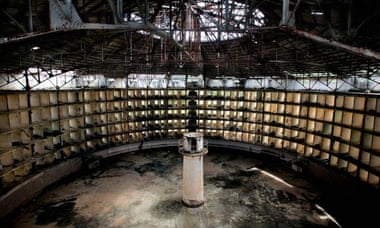 |
| Image 1: The abandoned Presidio Modelo complex in 1995 |
In
short, the large social network of Facebook is a virtual space of personal
place. Its geography dictates the exercise of power in this space and demonstrates the Panopticon Theory.
References
Allen,
J. (2003). Lost geographies of power. Malden,
MA: Blackwell.
Kuttainen, V. (2016). BA1002: Our space: Networks,
narratives and the making of place, lecture 2: Power. [PowerPoint
slides]. Retrieved from http://learnjcu.edu.au
Tuan, Y. (1977). Space and Place: The Perspectives of Experience. London, UK: Edward Arnold (Publishers) Ltd.

No comments:
Post a Comment